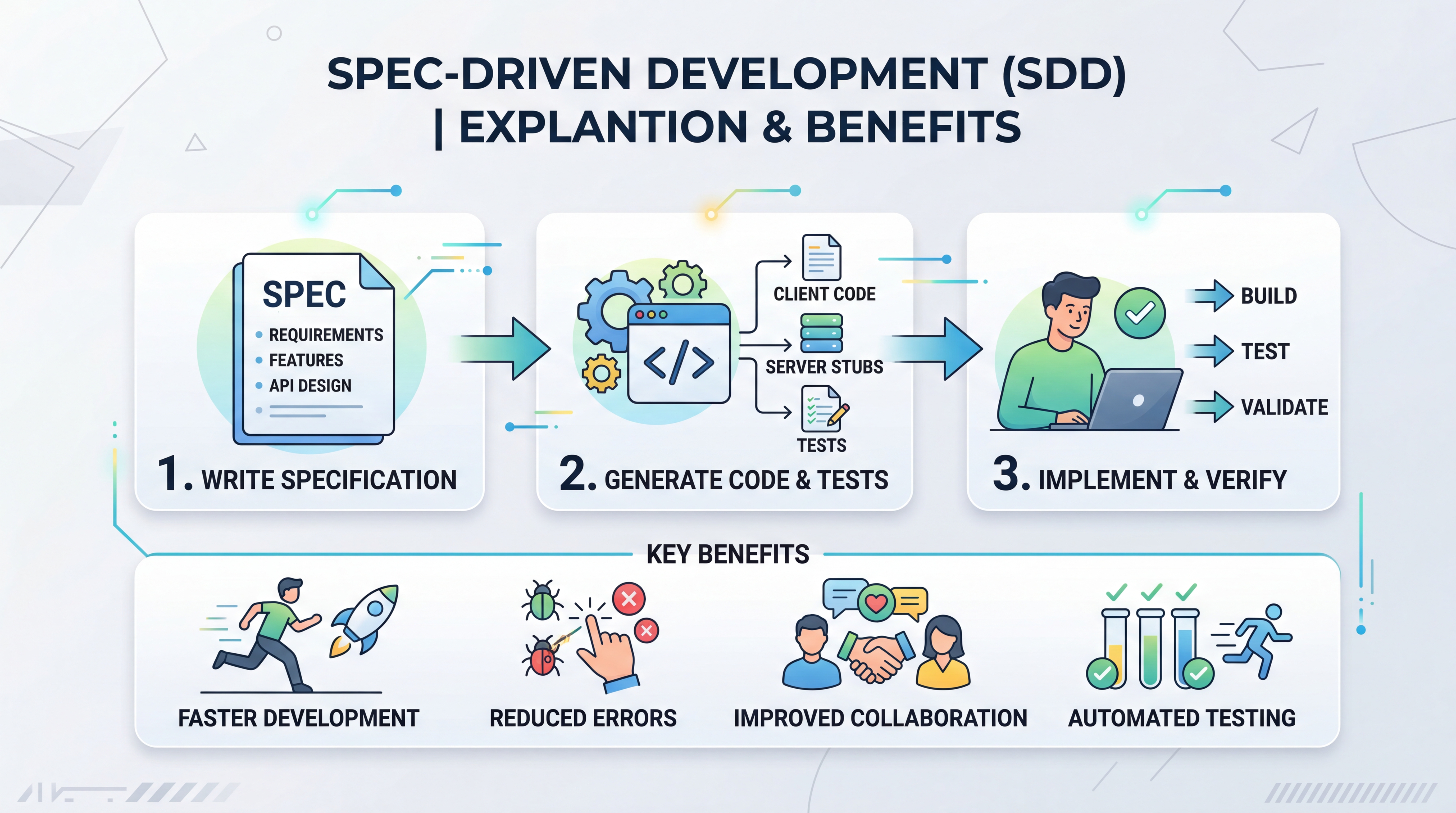
The Fifth Generation of Programming
Software engineering is entering its fifth generation. While previous shifts moved from machine code to high-level languages like Python, the current era is defined by Large Language Models (LLMs) and autonomous agents. However, unstructured AI coding, often called vibe coding creates systemic fragility.
Undirected AI coding increases code complexity by 41% and can inject security vulnerabilities into over 90% of outputs. Spec-Driven Development (SDD) is the disciplined response. SDD mandates that system intent and constraints be defined in machine-readable formats like OpenAPI, YAML, or Markdown before implementation. In SDD, the specification is the executable infrastructure; code is merely a transient byproduct.
Historical Roots of SDD
SDD evolved from decades of engineering theory. In the 1960s, NASA’s Mercury project used a “test-first” methodology because the cost of runtime failure was catastrophic. Engineers wrote formal test procedures based on mission requirements before programmers wrote a single line of code.
In 2004, researchers synthesized Test-Driven Development (TDD) and Design-by-Contract (DbC) into a unified SDD framework. While TDD verifies specific functional paths, DbC verifies universal invariants. Together, they ensure that code meets both functional requirements and environmental constraints.
The Productivity Paradox in Generative AI
AI has moved the software bottleneck upstream. Code is no longer scarce; clarity of intent is the limiting factor. Without a framework, AI tools can actually slow down experienced engineers by 19% due to the cognitive load of debugging “hallucinated” or architecturally inconsistent code.
LLMs are probabilistic inferrers, not deterministic compilers. SDD transforms the LLM from a chaotic generator into a constrained engine by forcing it to adhere to a centralized specification.
Methodological Distinctions
SDD operates at a higher architectural layer than previous agile methods and assumes the use of autonomous agents.
| Methodology | Primary Artifact | Scope | Validation Mechanism |
|---|---|---|---|
| TDD | Unit tests | Function correctness | Automated test suites |
| BDD | User scenarios | User behavior | Human-referenced docs |
| MDD | UML Models | System architecture | Proprietary compilers |
| SDD | Executable Specs | System contracts | Automated CI/CD gates |
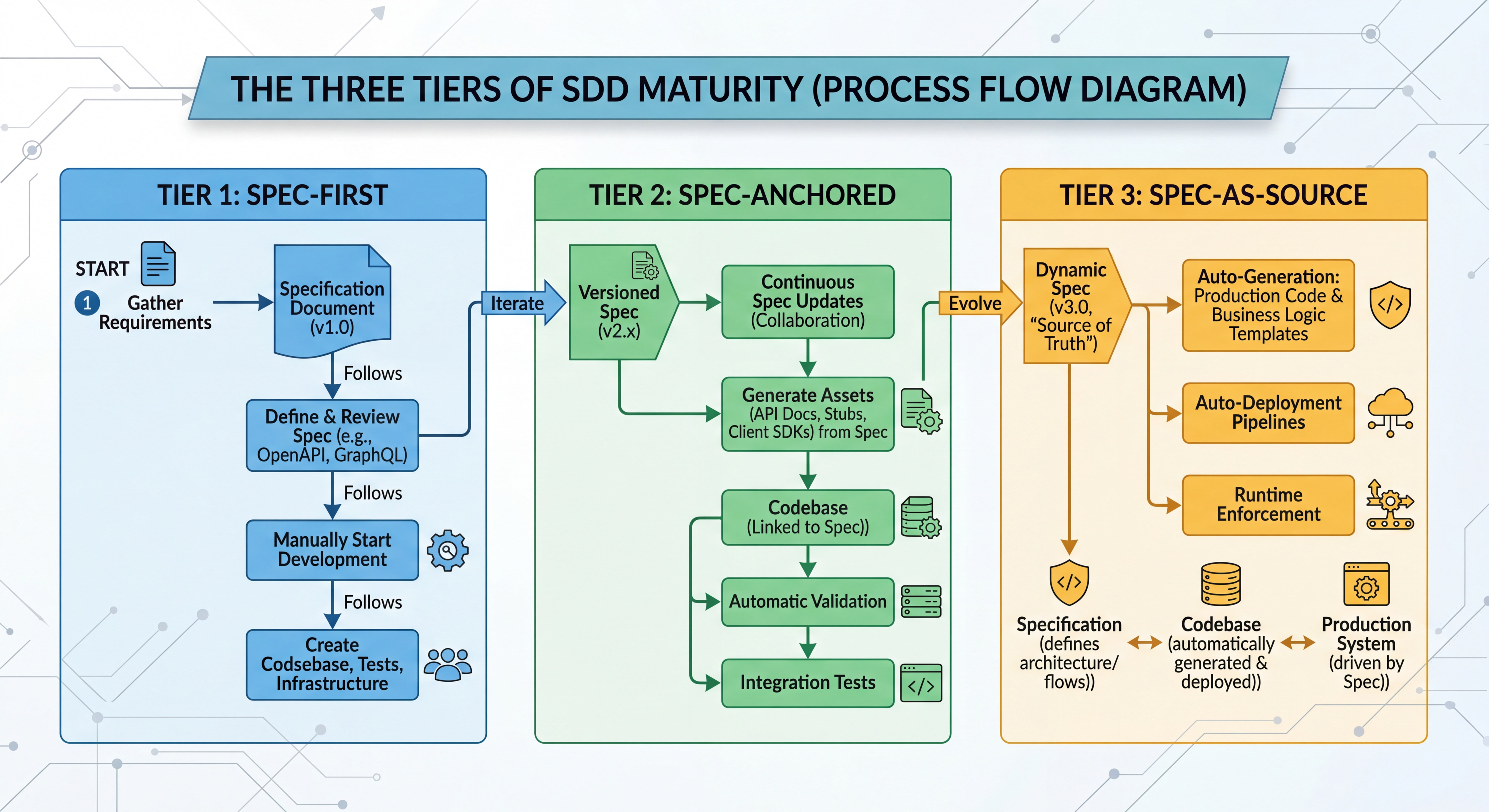
The Three Tiers of SDD Maturity
- Tier 1: Spec-First. The spec is written first but discarded after code generation. This leads to “context rot” during maintenance.
- Tier 2: Spec-Anchored. The spec is a living, version-controlled artifact. AI agents use it as a permanent anchor for all future refactoring.
- Tier 3: Spec-as-Source. Humans never edit code. The specification is the literal source code, and the LLM acts as the compiler.
Core Architecture of Spec-Native Systems
Mature SDD implementations use a five-layer execution model to ensure intent shapes execution.
- Specification Layer: The authoritative source of truth. Defines schemas, API contracts, and policy constraints.
- Generation Layer: Tools parse the spec to create a technical plan and dependency graph.
- Task Layer: Monolithic prompts are decomposed into atomic, isolated units of work for the AI.
- Artifact Layer: The actual source code generated by agents. This is transient and replaceable.
- Validation Layer: Continuous drift detection. CI/CD pipelines compare generated code against the spec and fail the build on any mismatch.
The SDD Lifecycle
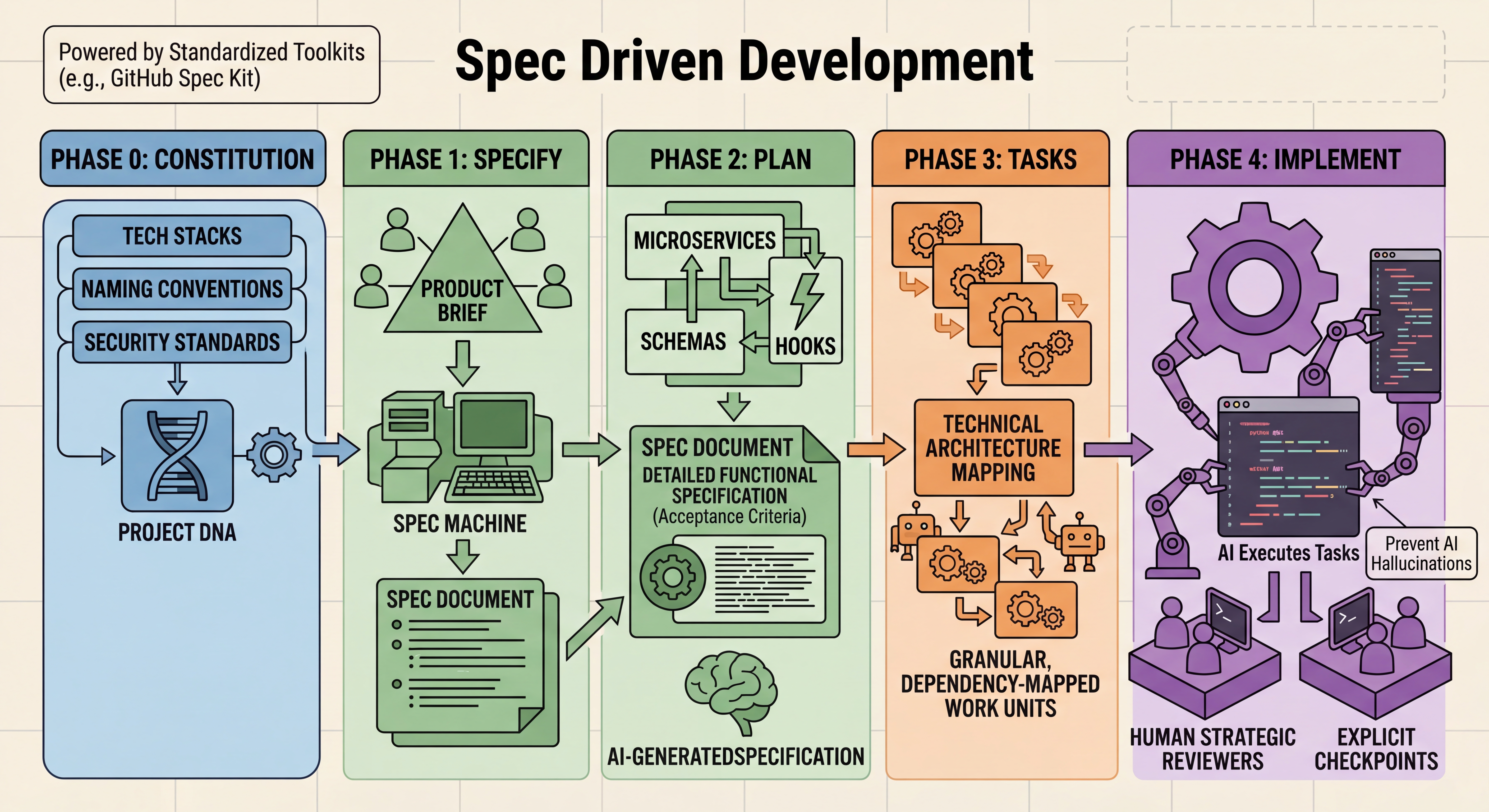
Standardized toolkits like the GitHub Spec Kit break development into five distinct phases:
- Phase 0: Constitution. Defines immutable project DNA, such as tech stacks, naming conventions, and security standards.
- Phase 1: Specify. Humans provide a product brief. AI generates a detailed functional specification with acceptance criteria.
- Phase 2: Plan. AI maps the spec to technical architecture (microservices, schemas, hooks).
- Phase 3: Tasks. The plan is fragmented into granular, dependency-mapped work units to prevent AI hallucinations.
- Phase 4: Implement. AI executes tasks. Humans act as strategic reviewers at explicit checkpoints.
Architecting Agentic Memory
LLMs are stateless and suffer from context window amnesia. SDD solves this using the Memory Bank paradigm: a structured system of Markdown files that serve as persistent long-term memory.
- projectbrief.md: Core requirements and goals.
- systemPatterns.md: Technical rules and design patterns.
- activeContext.md: Short-term memory for current focuses and micro-decisions.
- LessonsLearned.md: A persistent ledger of previous errors and their fixes. This prevents the AI from repeating historical mistakes.
The SDD Tooling Ecosystem
- GitHub Spec Kit: An agent-agnostic, open-source CLI that enforces human-in-the-loop validation at every stage.
- Tessl: A “Spec-as-Source” framework featuring a Spec Registry with over 10,000 vetted specifications for open-source libraries.
- Kiro: A VS Code extension that uses Property-Based Testing to verify specifications against randomized inputs, catching edge cases that standard tests miss.
The Rise of the Product Engineer
SDD commoditizes syntax generation, forcing human expertise up the abstraction ladder. The traditional silos of Product, Design, and Engineering are collapsing into the Product Engineer archetype.
Product Engineers “own the problem” rather than the code. They use a “T-shaped” skill set to synthesize user needs and system invariants into machine-readable instructions. Quality assurance shifts from syntax review to Specification Review. Misalignments caught at the spec level take minutes to fix, while those caught after code generation require complex rollbacks.
Conclusion
The era of manual syntax orchestration is ending. SDD is the necessary evolution of software architecture for the AI age. By making architecture executable rather than advisory, organizations can chain the probabilistic creativity of AI to the deterministic requirements of enterprise governance. In the AI-native future, the specification is the true source code.